TTWWADI
The best part of Jukes' session yesterday was at the end:
That's The Way We've Always Done It.
It amazing how we can embrace doing things the way they have always been done. It seems that once a decision has been made for a course of action, it is much easier to just continue going in the same direction than it is to reexamine the situation and re-evaluate the decision. With
all of the effort required to think your way through an issue, it is all too easy to just slip into a preexisting mind set. Often we have no idea where the mindset came from or how the original decision was made. We just accept things as they are because it is the path of least resistance. Here’s an example of what we are talking about.

The mindset of the rails
Today in the United States, the spacing between the rails on railroad tracks is always 4 feet, 8 1/2 inches - a rather odd and seemingly arbitrary number.
Why is that particular spacing always used?
Because that's the rail spacing they used to build the railroads in England, and English expatriates built the US railroads.
Why did the English use that particular spacing?
Because the same people who built horse-drawn wagons in the prerailroad era, and that’s the axle width wagon makers built the first railroad cars used.
Why did the wagon makers use that particular axle width?
They did this because, if they used any other axle spacing, the wagon wheels would break on the sides of the established wheel ruts.
So, where did those old rutted roads come from?
The first long distance roads in Britain and Europe were built by Imperial Rome for the use of the Roman military, and they have been in use ever since.
Why did the Romans use that particular axle spacing?
Roman war chariots formed the initial ruts in these first roads, and everyone ever since has had to adapt to those ruts to avoid destroying their wheels.
Thus the United States standard railroad track spacing of 4 feet, 8 1/2 inches derives from the original specification for an Imperial Roman war chariot.
What this all means
Specifications, bureaucracies, institutions, and systems have a natural tendency to solidify in their ways, requiring people to do things the same way they have traditionally been done. This, despite the fact the world is changing around us all the time. In this situation, you might
find yourself sometimes asking, "What horse's ass came up with this way of doing things?" In the case of the railways, you would be closer to the truth than you imagined, because the Imperial Roman war chariots were made just wide enough to accommodate two horses asses.

Indeed, a horse's ass did originally determine the way we do some things now, and we finally have the answer to the original question. That’s TTWWADI!
And there’s more
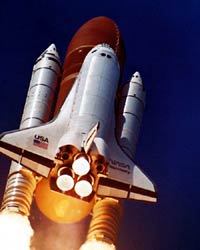
There's new twist to the story about railroad track spacing and horses' behinds. When we see a space shuttle sitting on its launch pad, there are two big booster rockets attached to the sides of the main fuel tank. These are solid rocket boosters, or SRBs, which are made at the ATK Thiokol Propulsion factory in Utah. The engineers whodesigned the SRBs might have preferred to make them a bit fatter,but the SRBs have to be shipped by train from the factory in Utah to the launch site in Florida. The railroad line from the factory runs through various tunnels in the mountains. The tunnels are slightly wider than the railroad track, and the railroad track is about as wide as two horses' behinds. So, a major design feature of what is arguably the world's most
advanced transportation system was determined over 2000 years ago by the width of a horse's ass! That’s TTWWADI!
This has been copied from Ian Jukes' website at
http://ianjukes.com/infosavvy/education/handouts/ttwwadi.pdf
That's The Way We've Always Done It.
It amazing how we can embrace doing things the way they have always been done. It seems that once a decision has been made for a course of action, it is much easier to just continue going in the same direction than it is to reexamine the situation and re-evaluate the decision. With
all of the effort required to think your way through an issue, it is all too easy to just slip into a preexisting mind set. Often we have no idea where the mindset came from or how the original decision was made. We just accept things as they are because it is the path of least resistance. Here’s an example of what we are talking about.
The mindset of the rails
Today in the United States, the spacing between the rails on railroad tracks is always 4 feet, 8 1/2 inches - a rather odd and seemingly arbitrary number.
Why is that particular spacing always used?
Because that's the rail spacing they used to build the railroads in England, and English expatriates built the US railroads.
Why did the English use that particular spacing?
Because the same people who built horse-drawn wagons in the prerailroad era, and that’s the axle width wagon makers built the first railroad cars used.
Why did the wagon makers use that particular axle width?
They did this because, if they used any other axle spacing, the wagon wheels would break on the sides of the established wheel ruts.
So, where did those old rutted roads come from?
The first long distance roads in Britain and Europe were built by Imperial Rome for the use of the Roman military, and they have been in use ever since.
Why did the Romans use that particular axle spacing?
Roman war chariots formed the initial ruts in these first roads, and everyone ever since has had to adapt to those ruts to avoid destroying their wheels.
Thus the United States standard railroad track spacing of 4 feet, 8 1/2 inches derives from the original specification for an Imperial Roman war chariot.
What this all means
Specifications, bureaucracies, institutions, and systems have a natural tendency to solidify in their ways, requiring people to do things the same way they have traditionally been done. This, despite the fact the world is changing around us all the time. In this situation, you might
find yourself sometimes asking, "What horse's ass came up with this way of doing things?" In the case of the railways, you would be closer to the truth than you imagined, because the Imperial Roman war chariots were made just wide enough to accommodate two horses asses.
Indeed, a horse's ass did originally determine the way we do some things now, and we finally have the answer to the original question. That’s TTWWADI!
And there’s more
There's new twist to the story about railroad track spacing and horses' behinds. When we see a space shuttle sitting on its launch pad, there are two big booster rockets attached to the sides of the main fuel tank. These are solid rocket boosters, or SRBs, which are made at the ATK Thiokol Propulsion factory in Utah. The engineers whodesigned the SRBs might have preferred to make them a bit fatter,but the SRBs have to be shipped by train from the factory in Utah to the launch site in Florida. The railroad line from the factory runs through various tunnels in the mountains. The tunnels are slightly wider than the railroad track, and the railroad track is about as wide as two horses' behinds. So, a major design feature of what is arguably the world's most
advanced transportation system was determined over 2000 years ago by the width of a horse's ass! That’s TTWWADI!
This has been copied from Ian Jukes' website at
http://ianjukes.com/infosavvy/education/handouts/ttwwadi.pdf
posted by FF at
4/04/2006 03:17:00 PM


1 Comments:
I hope to be able to blog from the road, at least while I am in Rome. Apparently the last two weeks are located in the middle of nowhere, which kind of scares me.
By FF, at 12:42 AM
Post a Comment
<< Home